How Traffic Cameras Work in Qatar 2026


 May 21, 2026 7:54 pm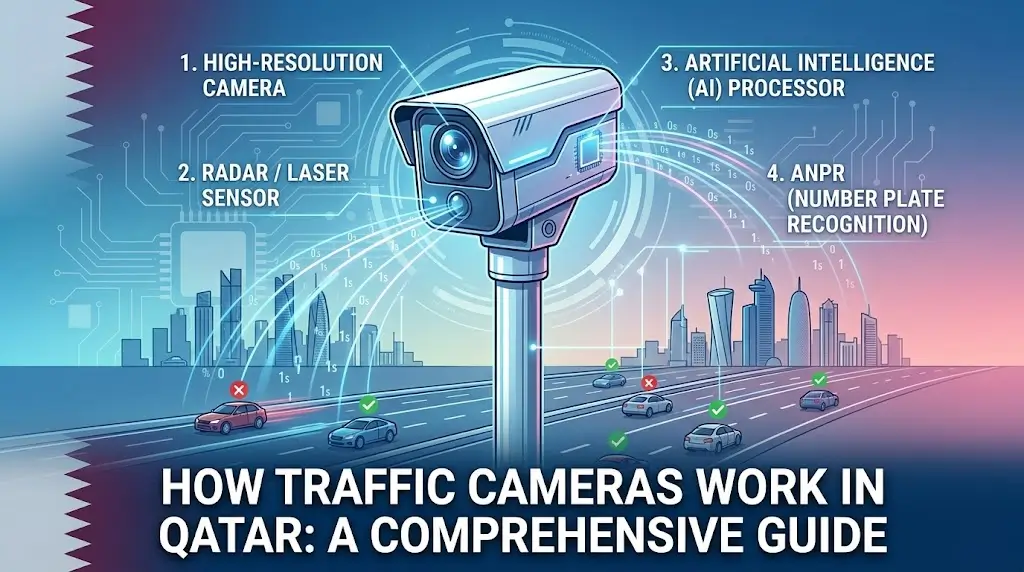
Traffic cameras are now a major part of Qatar’s road safety system and can be seen across highways, intersections, and busy city roads – fixed on poles, sitting above traffic lights, and mounted on overhead structures across every major road. What surprises most drivers is that these are not simple recording devices. They are part of a fully automated enforcement system that works around the clock.
Understanding how this system works helps you drive smarter, avoid unnecessary fines, and stay on the right side of Qatar’s road safety laws.
Why Qatar Uses Traffic Cameras
Qatar’s road network grew rapidly, and manual enforcement could not keep pace. The government invested heavily in modern traffic monitoring technology, with the entire system managed by the Ministry of Interior and the Traffic Department through a centralized platform.
The system is built to:
- Monitor road safety in real time
- Detect traffic violations automatically
- Collect verified evidence for traffic fines
- Reduce reckless driving across highways and city roads
- Improve overall traffic management without needing officers at every location
Types of Traffic Cameras Work in Qatar
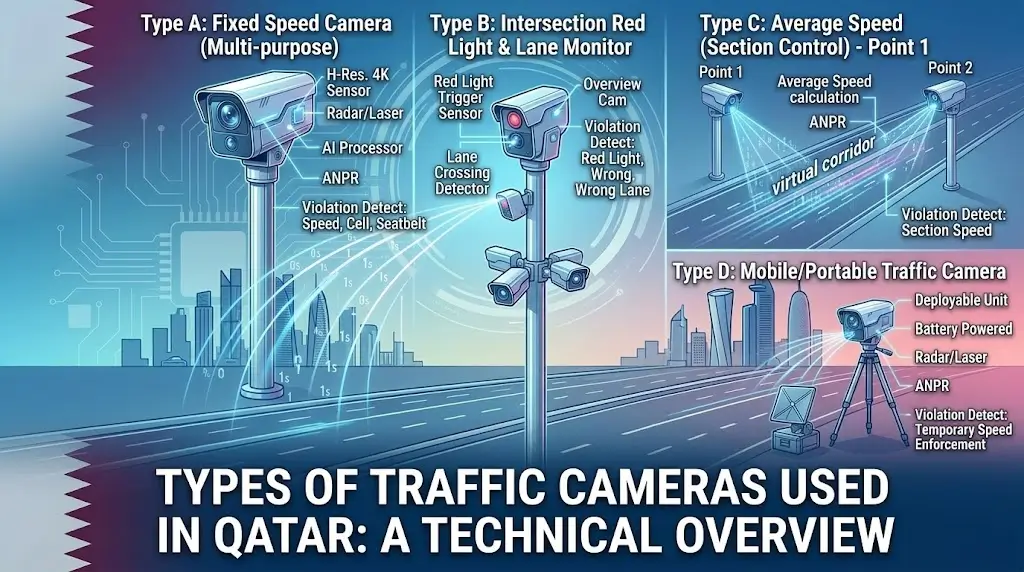
Different cameras are placed at specific locations to monitor particular driving behaviors. Each one connects to the same centralized traffic enforcement system.
| Camera Type | Purpose | Common Locations |
|---|---|---|
| Speed Cameras | Detect vehicles exceeding speed limit | Highways, major roads |
| Red Light Cameras | Capture vehicles crossing on red signal | Traffic intersections |
| Mobile Radar Cameras | Temporary speeding monitoring | Different road areas |
| ANPR Cameras | Automatic Number Plate Recognition | City roads, checkpoints |
| Surveillance Cameras | General traffic monitoring | Busy roads, junctions |
Key Components and Technology Behind Traffic Cameras
Qatar’s traffic cameras are active detection systems, not passive recorders. Multiple components work together in real time to identify violations instantly.
| Component | Function |
|---|---|
| High-Resolution Camera | Captures sharp images of vehicle and license plate |
| Radar / Laser Sensor | Measures precise vehicle speed |
| Infrared Sensors | Checks seatbelt compliance and works in low-light conditions |
| Artificial Intelligence (AI) | Identifies violation types and automates the detection process |
| ANPR | Extracts license plate numbers and checks the traffic database |
| Data Transmission System | Sends violation data to MOI central command center in real time |
Artificial intelligence helps the system identify violations faster and more accurately, especially in heavy traffic and low-light conditions. It detects mobile phone use even when the phone is held low, processes violations at higher speeds, and handles everything automatically until human verification takes place.
How Speed Cameras Work in Qatar
Unpaid traffic fines in Qatar can lead to additional penalties, vehicle registration restrictions, and possible legal action depending on the severity of the violation.
- Fixed Speed Cameras – Mounted permanently on poles using radar or laser technology. When a vehicle exceeds the speed limit at that point, the sensor triggers the camera and captures the image. The recorded data includes the vehicle number plate, speed, location, date, and time of the offense.
- Average Speed Cameras (Section Control) – Placed at two points on a road, these cameras calculate the average speed between point A and point B. Even if you stay within the limit at each individual point, arriving at point B too quickly still registers a violation. This system continuously monitors rather than capturing a single moment.
All captured data is transmitted to the traffic control system where the violation is verified before a fine is issued.
How Red Light Cameras Detect Violations
Red light cameras are installed at major intersections and activate automatically the moment the signal turns red. No manual triggering is needed.
When a vehicle crosses the stop line after the signal changes, the camera captures a sequence of images recording:
- Vehicle position just before crossing
- The moment the vehicle crosses the stop line
- A clear image of the license plate number
- The signal status at the exact time of the violation
This layered evidence makes red light violations very difficult to dispute. Authorities use the full image sequence to confirm the offense and apply the appropriate penalty.
Automatic Number Plate Recognition (ANPR)
ANPR technology works quietly in the background across Qatar’s road network. These cameras scan and read vehicle license plates using advanced image processing software, completing the entire lookup within seconds.
Once a plate is captured, the data is checked against the central database to:
- Identify stolen vehicles
- Detect expired vehicle registrations
- Track vehicles linked to violations
- Monitor traffic flow across city roads and checkpoints
By the time a vehicle passes the camera, its plate has already been extracted, identified, and verified – fully automated with no delay.
Beyond Speeding: Other Traffic Violations Detected
Modern AI cameras in Qatar, known locally as Tala’a systems, detect far more than just speeding. These systems are built to handle multiple violation types simultaneously:
- Mobile Phone Usage – High-resolution imaging combined with AI algorithms detects phone use even when the device is held low inside the vehicle
- Seatbelt Violations – Infrared technology and pattern recognition check seatbelt compliance automatically while the vehicle is in motion
- Red Light Violations – Intersection cameras catch vehicles that skip red lights using multi-image sequencing
- Lane Discipline – Cameras monitor whether heavy vehicles stay in their dedicated lanes and flag improper lane changes
- READ ALSO :Traffic Fines Not Showing
Qatar continuously upgrades its traffic monitoring systems to improve accuracy and reduce traffic violations across the country.
How Drivers Are Notified About Traffic Fines
After a violation is recorded, data is immediately transmitted to MOI central command centers. A validation process with human verification takes place before any fine is officially issued.
Once confirmed, drivers can check and pay fines through these official platforms:
| Platform | Access |
|---|---|
| MOI Website | View and pay penalties online |
| MOI Mobile Application | Check fine details from your phone |
| Metrash2 App | Full MOI services including violation inquiry |
All three platforms allow you to view violations, check fine details, and pay penalties online using your license plate number. Drivers can usually check their traffic violations online within seconds using official MOI platforms.
Common Traffic Violations Detected by Cameras
Qatar’s camera network detects a wide range of driving offenses automatically and accurately:
| Violation Type | Description |
|---|---|
| Overspeeding | Driving above the posted speed limit |
| Red Light Violation | Crossing an intersection on a red signal |
| Lane Violations | Improper lane usage or sudden lane changes |
| Illegal Turns | Turning where traffic signs prohibit it |
| Dangerous Driving | Reckless or aggressive driving behavior |
| Mobile Phone Usage | Using a phone while driving |
| Seatbelt Violation | Not wearing a seatbelt while driving |
Benefits of Traffic Cameras in Qatar
Qatar’s advanced traffic camera system has helped improve road safety, reduce reckless driving, and support better traffic management across the country.
- Significant reduction in road accidents and fatalities
- Improved driver discipline across highways and city roads
- Faster traffic law enforcement without constant physical police presence
- Better traffic monitoring at busy junctions and intersections
- Enhanced public safety including pedestrian protection through signal countdowns
Continuous traffic monitoring has helped improve driving discipline and road safety across Qatar. The data collected also feeds back into broader traffic management decisions, making Qatar’s road network more efficient overall.
Tips to Avoid Traffic Camera Fines
Staying fine-free in Qatar comes down to consistent habits. The violations that catch most drivers off guard are average speed cameras and seatbelt checks – both easy to overlook without realizing iFAQS
How to Check Traffic Camera Fines in Qatar
Drivers in Qatar can easily check traffic fines online through official Ministry of Interior platforms. Users simply need their vehicle number plate details to view pending violations and payment information.
The most commonly used platforms include:
These platforms allow drivers to check violation details, fine amounts, payment status, and offense dates within seconds.
FAQS
How do traffic cameras detect speeding in Qatar? Speed cameras use radar or laser technology to measure vehicle speed at a specific point. If the vehicle exceeds the allowed speed limit, the camera automatically captures the license plate, speed, location, date, and time. Average speed cameras go further by calculating speed between two points on the road.
What is the Tala’a camera system in Qatar? Tala’a refers to Qatar’s modern AI-powered traffic cameras. These systems go beyond speeding and detect mobile phone usage, seatbelt violations, red light offenses, and lane discipline issues — all automatically using high-resolution imaging and artificial intelligence.
How will I know if I received a traffic fine in Qatar? Fines are registered in the MOI system after human verification. You can check your violations through the MOI website, MOI mobile application, or the Metrash2 app using your license plate number.
Can traffic camera fines be disputed in Qatar? Disputes can be raised through the Ministry of Interior. However, because cameras capture multiple images and use AI-based verification alongside human review, successful disputes are uncommon unless there is a clear technical error.
What violations do red light cameras detect? Red light cameras detect vehicles that cross the stop line after the traffic signal turns red. The system captures a sequence of images showing the vehicle position, the stop line crossing, the license plate, and the signal status at the time making the evidence very difficult to challenge.
Does ANPR only detect speeding violations? No. ANPR cameras identify vehicles instantly by scanning license plates and checking them against the central database. They are used to detect stolen vehicles, expired registrations, and vehicles linked to existing violations – not just speeding.
What are the best times to avoid traffic camera issues in Qatar? There are no safe times to ignore traffic rules in Qatar. Cameras operate continuously, and AI systems process violations at all hours. The only reliable way to avoid fines is to follow posted speed limits, wear your seatbelt, stop at red lights, and keep your phone away while driving.
Official Traffic Resources in Qatar
Drivers can verify traffic laws, fines, and violation details through official Qatar government platforms managed by the Ministry of Interior (MOI).
Official resources include:
- Ministry of Interior Qatar (MOI)
- Metrash2 Mobile Application
- Qatar Traffic Department Services
Using official platforms helps drivers access accurate and updated traffic information directly from government sources.
Conclusion
Traffic cameras in Qatar are far more advanced than most drivers realize. From fixed speed cameras and red light sensors to AI-powered Tala’a systems and ANPR technology, every major road in Qatar is monitored with precision and accuracy.
Qatar’s traffic camera system plays an important role in improving road safety and encouraging responsible driving habits across the country. Drivers who follow speed limits, traffic signals, and seatbelt rules can easily avoid fines and drive safely on Qatar’s roads. Understanding how these camera systems work also helps residents and visitors stay informed about Qatar’s traffic laws and enforcement process..
Faraz khan 
faraz khan is a researcher and writer specializing in MOI Qatar traffic violations and fines. He shares simple guides on how to check traffic violations, understand fines, and pay penalties online through the MOI portal. His goal is to help drivers in Qatar easily manage their traffic records and avoid unnecessary penalties.