Most Common Driving Mistakes in Qatar Avoid These to Stay Safe 2026


 April 28, 2026 11:45 am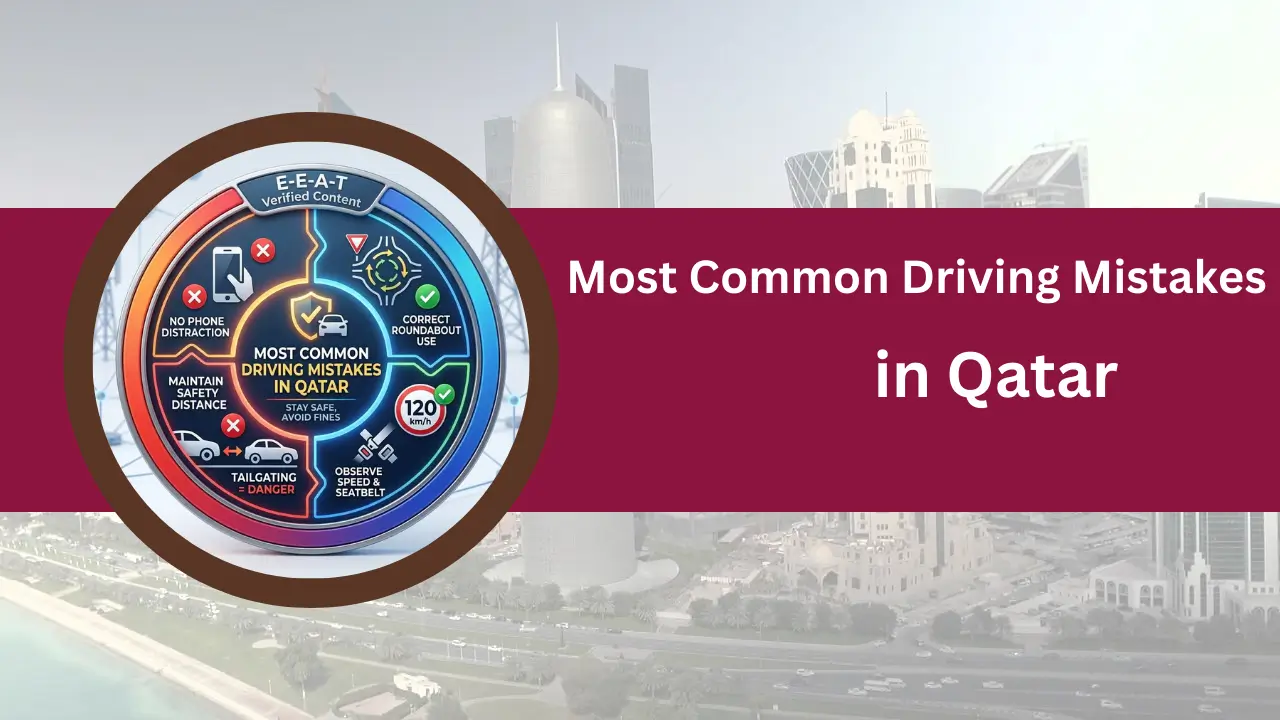
Qatar’s roads are modern and well-maintained, but that does not mean they are forgiving. New residents, visitors, and even experienced drivers make the same mistakes repeatedly and in Qatar, those mistakes come with real consequences like heavy fines, black points, and license penalties.
The good news is that most of these errors are completely avoidable. Once you know what to watch out for, staying safe and fine-free on Qatar’s roads becomes a lot more straightforward.Moi Traffic Violations
Using Mobile Phones While Driving Mistakes
Picking up your phone while driving is one of the fastest ways to cause an accident in Qatar. A few seconds of distraction at highway speed covers more ground than most drivers realise – enough for something to go seriously wrong.
Qatar traffic law prohibits holding a phone while driving unless you are using a hands-free device. The penalties are not light either.
| Violation | Possible Consequence |
|---|---|
| Using phone while driving | Traffic fine |
| Distracted driving accident | License points + heavy penalties |
| Repeated violation | Higher fines or legal action |
Easy fix:
- Mount your phone on a dashboard holder before you start driving
- Use a Bluetooth system for calls and navigation
- If something urgent comes up, pull over safely before checking your phone
Sudden Lane Changing Without Indicators
Changing lanes without signaling is one of the most common causes of collisions on busy roads like the Doha Expressway. Other drivers have no warning, no time to adjust their speed, and nowhere to go.
Where this happens most:
- Busy highways and expressways
- Entering or exiting roundabouts
- Overtaking slower vehicles
How to do it right:
- Signal at least 2–3 seconds before changing lanes
- Check your rear-view mirror, side mirrors, and blind spots first
- Turn the signal off after completing the lane change
- Never switch lanes inside a roundabout without signaling
Tailgating (Driving Too Close)
Following too closely is dangerous at any speed – but on Qatar’s high-speed roads, it leaves almost no reaction time if the car ahead brakes suddenly. Rear-end collisions from tailgating are entirely preventable.
| Safe Distance Rule | When to Apply |
|---|---|
| 2-Second Rule | Minimum distance at all times |
| 3–4 Seconds | High-speed roads and highways |
| More than 4 Seconds | Bad weather or low visibility |
The 2-second rule is the floor, not the target. In bad weather or heavy traffic, increase that gap further especially since strict enforcement under Qatar Driving License Suspension Rules can lead to penalties and possible driving restrictions if violations continue.
Ignoring Speed Limits
Speed cameras are placed on residential streets, city roads, and highways across Qatar — and they work automatically. There is no margin for guessing or assuming the system missed you.
| Road Type | Speed Limit |
|---|---|
| Residential areas | 50–60 km/h |
| City roads | 60–80 km/h |
| Highways | 100–120 km/h |
Things to keep in mind:
- Always watch for radar signs and speed limit boards
- Adjust your speed based on road conditions and traffic flow — not just the posted limit
- Driving too slowly on highways also creates hazards for drivers behind you
Improper Use of Roundabouts
Roundabouts are everywhere in Qatar, and getting them wrong is one of the most consistent mistakes on the road. The rule is simple vehicles already inside the roundabout have priority but many drivers ignore it.
Common roundabout mistakes:
- Entering without giving way to vehicles already inside
- Changing lanes inside the roundabout without signaling
- Exiting suddenly without indicating to drivers behind
How to navigate roundabouts correctly:
- Always yield to traffic already in the roundabout
- Plan your lane position before you enter, not after
- Signal clearly when changing lanes or exiting
- Give way to pedestrians at crossings around the roundabout
Not Wearing Seat Belts
Seat belts are mandatory for the driver and all front-seat passengers in Qatar. It is one of the simplest safety rules on the road and still one of the most ignored.
| Violation | Result |
|---|---|
| No seat belt | Traffic fine |
| Repeated violation | Higher penalties |
| Accident without seat belt | Risk of serious injury increases by over 50% |
There is no situation on the road where skipping a seat belt makes sense. It takes two seconds to put on and reduces serious injury risk by more than half.
Running Red Lights
Running a red light in Qatar is a serious offense. Advanced cameras at intersections detect violations automatically – there is no room for error or appeal on the grounds of not seeing the light.
Consequences include:
- Large traffic fines
- Black points on your driving license
- Vehicle impoundment in severe cases
The most common trigger is accelerating through a yellow light instead of slowing down. When a light turns yellow, the right move is always to slow down and prepare to stop – not speed up to beat it.
Blocking Intersections
Stopping inside a junction during traffic congestion is a mistake many drivers do not even register as a violation. The car ahead moved, there appeared to be space, and then the light changed. Now the driver is blocking cross traffic and creating delays in every direction.
How to avoid it:
- Only enter an intersection when the road ahead is fully clear
- Never stop in the middle of a junction regardless of traffic behind you
- At stop signs, come to a complete stop not a slow roll
Failure to Check Mirrors and Blind Spots
Mirrors need to be checked constantly not just before lane changes, but as a regular habit throughout every drive. Blind spots are the particular danger on highways where vehicles can sit entirely outside mirror range.
Good mirror and observation habits:
- Check rear-view and side mirrors regularly while driving
- Always glance over your shoulder to check blind spots before merging or changing lanes
- Follow this sequence every time: mirror check → blind spot glance → signal → move
- Never rely on mirrors alone when merging onto a highway
Poor Lane Discipline
Drifting between lanes, straddling lane markings, or not maintaining a steady position in the correct lane creates unpredictability for everyone around you. On a driving test, these are immediate failure points. On real roads, they are collision risks.
How to maintain good lane discipline:
- Stay within your lane markings at all times
- Use signals every time you change lanes – no exceptions
- Keep a consistent, steady path through the lane
- Stay mindful of your lane position especially on multi-lane roads
Faulty Parking and Parallel Parking Errors
Misjudging a parking space, failing to park within the lines, or struggling through a parallel parking maneuver are mistakes that come from a lack of consistent practice. In a test environment they lead to failure. On the road they cause obstruction and frustration for other drivers.
Common parking mistakes:
- Hitting the curb during parallel parking
- Parking at an angle outside the designated lines
- Misjudging the space before committing to the maneuver
How to improve:
- Practice parallel and perpendicular parking regularly with a qualified instructor
- Always assess the parking space carefully before pulling in
- Take your time rushing a parking maneuver leads to errors every time
Ignoring Traffic Signs and Pedestrian Crossings
Road signs are placed to communicate information the driver cannot always see ahead. Disregarding a stop sign, misreading a yield sign, or missing a speed limit board creates both a violation and a genuine safety risk.
Pedestrian crossings deserve special attention. Pedestrians have the right of way at marked crosswalks, and failing to yield to them is both a legal violation and a serious safety issue.
Good habits around signs and crossings:
- Study Qatar traffic signs and local traffic laws thoroughly
- Pay close attention to stop, yield, and speed limit signs at all times
- Always slow down and yield to pedestrians at designated crossings
- Never assume a crossing is empty – check before proceeding
Nervous Driving and Lack of Smooth Control
Nervousness affects driving in ways that are hard to control in the moment. Hesitation at intersections, jerky acceleration and braking, and excessive caution all signal a driver reacting emotionally rather than driving with skill. In a test setting this reads as poor smooth control. On real roads it creates confusion for everyone around you.
How to drive more smoothly and confidently:
- Keep both hands on the steering wheel in the correct position at all times
- Practice relaxation techniques before getting behind the wheel
- Focus on smooth, gradual acceleration and braking rather than sudden inputs
- Build confidence through regular practice with an experienced instructor
Ignoring Traffic and Road Conditions
Driving the same way regardless of what is happening around you is a risk that catches many drivers off guard. Weather, traffic flow, and road conditions change constantly – and the driver who does not adapt is the one who ends up in an accident.
How to stay adaptive on the road:
- Slow down in bad weather or low visibility conditions
- Increase following distance in heavy traffic
- Practice defensive driving – anticipate dangers early rather than reacting late
- Know your emergency procedures including how to stop safely and when to contact emergency services
Quick Summary of Common Driving Mistakes
| Driving Mistake | Risk Level | Main Problem |
|---|---|---|
| Using phone while driving | High | Distracted driving |
| Sudden lane changes | High | Collision risk |
| Tailgating | High | Rear-end accidents |
| Speeding | High | Radar fines |
| Roundabout mistakes | Medium | Traffic confusion |
| No seat belt | High | Safety risk |
| Running red lights | Very High | Major accidents |
| Blocking intersections | Medium | Traffic delays |
| Poor mirror checks | High | Blind spot accidents |
| Poor lane discipline | High | Unpredictable driving |
Tips to Avoid Mistakes During the Driving Test
Passing the Qatar driving test comes down to building the right habits through consistent practice — not cramming on the day.
What actually helps:
- Practice regularly with a reputable driver’s education program and experienced instructors
- Take mock driving tests to identify weak areas and focus your practice
- Familiarise yourself with common test routes before the exam day
- Study traffic laws and Qatar traffic signs thoroughly
- Do a pre-test vehicle check – confirm lights, signals, and brakes are working
- Practice parallel and perpendicular parking until it feels natural
- Keep both hands on the steering wheel throughout the test
- Use the correct signal and mirror sequence every single time
Every driver has a unique learning curve. Mistakes during practice are part of the process – the key is to learn from them and keep improving.
Frequently Asked Questions
Q1: What is the most common driving mistake in Qatar?
Using a mobile phone while driving and speeding are consistently the most reported violations. Both are detected automatically by cameras and monitoring systems across Qatar’s roads.
Q2: What happens if you run a red light in Qatar?
Running a red light results in a large traffic fine, black points added to your driving license, and in serious cases, vehicle impoundment. Advanced cameras at intersections detect violations automatically.
Q3: Is tailgating illegal in Qatar?
Yes. Driving too close to the vehicle ahead is a traffic violation in Qatar. Maintaining a safe following distance at minimum the 2-second rule – is required by law and enforced on the roads.
Q4: What are the speed limits on Qatar roads?
Speed limits vary by road type – 50 to 60 km/h in residential areas, 60 to 80 km/h on city roads, and 100 to 120 km/h on highways. Speed cameras enforce these limits automatically.
Q5: Are seat belts mandatory in Qatar?
Yes. Seat belts are mandatory for the driver and all front-seat passengers. Failing to wear one results in a traffic fine, and repeated violations lead to higher penalties.
Q6: How do roundabouts work in Qatar?
Vehicles already inside the roundabout have priority. Drivers entering must give way, signal when changing lanes or exiting, and never cut across lanes to reach their exit.
Q7: How can I prepare for the Qatar driving test?
Practice regularly with a qualified instructor, take mock driving tests, study Qatar traffic signs and local traffic laws, familiarise yourself with common test routes, and practice parking maneuvers until they feel natural. Consistency in practice is what makes the difference.
Q8: Can nervousness affect my driving test result in Qatar?
Yes. Nervous driving often shows up as hesitation, jerky inputs, or excessive caution all of which affect the test result. Regular practice, relaxation techniques, and building confidence with an experienced instructor help manage this effectively.
Conclusion
Most driving mistakes in Qatar are not the result of recklessness – they come from habits that drivers never stopped to question. Whether it is picking up a phone, skipping a signal, or following too closely, these small errors add up to real consequences: fines, accidents, and license penalties. The roads in Qatar are well-built and the traffic rules are clear. Drive within them, stay aware of what is happening around you, and the roads here are genuinely safe to navigate every day.
Faraz khan 
faraz khan is a researcher and writer specializing in MOI Qatar traffic violations and fines. He shares simple guides on how to check traffic violations, understand fines, and pay penalties online through the MOI portal. His goal is to help drivers in Qatar easily manage their traffic records and avoid unnecessary penalties.